
Not all of us love bulky setups; some of us prefer direct connections – connecting our speakers directly to the playback device without introducing a receiver or amp in-between the connection.
How To Connect a Record Player to Speakers Without Using a Receiver? Get a set of passive speakers and a turntable with a built-in amp.
Actually, receivers and amps are introduced to help improve the sound quality, but most speakers are already built to deliver the best sound you need to hear without further tweaking.
If you don’t want a bulky setup and wish to connect your record player directly to your speaker, this article clearly explains how you can do that.
But before that, let’s discuss the need for receivers; do they actually play an important role in home audio setups?
Table of Contents
- 1 Functions of Audio Receivers
- 2 How does a Phono Preamp convert vinyl signals to speaker-ready audio?
- 3 How To Connect Record Player To Speakers Without Receiver
- 4 Things To Note:
- 5 Can I use studio monitors for my home turntable setup?
- 6 Best Vinyl Record Turntable To Buy
- 7 What More?
- 8 What is the “Don’t Forget” checklist for a receiver-free vinyl setup?
- 9 Explainer Video
- 10 FAQ
Functions of Audio Receivers
An Audio/Video Receiver (AVR) is an audio device that receives audio and video signals from multiple sources and then sends the signals to the connected speakers.
Apparently, AVRs come with control knobs and buttons that help you to tweak and control the sound that is being transmitted to your speakers from different sources.
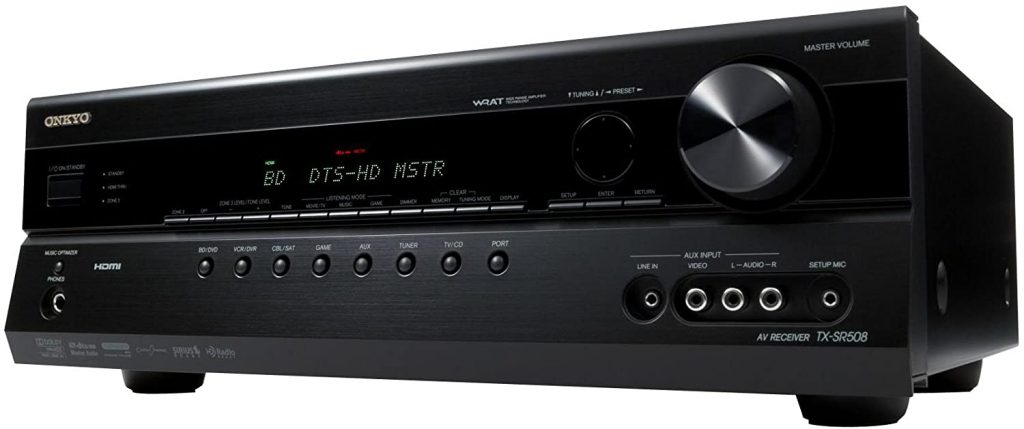
A receiver also amplifies the signals it receives from the source, increasing the signals to be able to drive the connected speakers.
No doubt, receivers play an important role in home audio setup, especially if you plan to transmit sound/video from various sources, which may include your TV, recorder player, DVD, console, etc.
But, you can do without a receiver; if you’re just looking to connect one device to your speakers, there’s definitely no need for a receiver.
How does a Phono Preamp convert vinyl signals to speaker-ready audio?
A phono preamp (or RIAA equalization stage) is essential because turntables output a “Phono” signal, which is significantly weaker than the “Line Level” signal required by active speakers. The preamp boosts the tiny millivolt signal from the stylus by up to 40–50 decibels (dB) while restoring the bass frequencies lost during the vinyl pressing process.
Understanding RIAA Equalization and Signal Path
In our testing at MyHomeSpeakers, we’ve found that skipping a dedicated preamp often results in a thin, tinny sound. To get the best audio without a receiver, you must manage the signal path correctly between these technical entities:
- Phono Cartridge (MM vs. MC): Moving Magnet (MM) cartridges are standard; Moving Coil (MC) requires higher gain from your preamp.
- Active Crossovers: Unlike passive setups, active speakers like the Audioengine A5+ or Klipsch The Fives use internal crossovers to split the amplified signal after the preamp stage.
- Total Harmonic Distortion (THD): High-quality standalone preamps like the Schiit Mani or Pro-Ject Phono Box offer lower THD than the “built-in” preamps found in budget turntables.
- Signal-to-Noise Ratio: Using shielded RCA cables helps maintain a high signal-to-noise ratio, preventing that annoying 60Hz hum.
How To Connect Record Player To Speakers Without Receiver
The most important to consider here is the type of connection supported by your record player. In other words, how does your record player connect with other audio/video players?
Does the record player support RCA, 3.5mm jack, or another type of connector. Once you have this figured out, you’ve most definitely solved up to 50% of the issue; thus, making the remaining processes a non-issue.
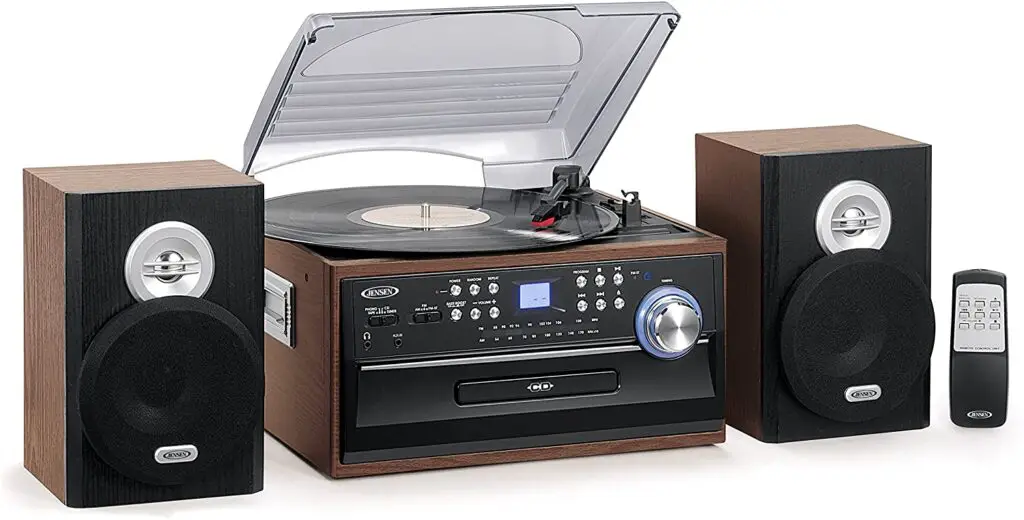
Well, there is a big problem here; the type of speaker(s) you have may also be a hindrance to this setup. Wondering how that could happen?
Yeah, a turntable, or record player as many may call it, typically does not support a connector where you can fix in speaker wires.
So, if your speakers are such that only use “Speaker wires” to connect to a source, you need a new set of speakers.
That said, just as you’re figuring out the type of connectors is available on your record player, you also need to check the type of connectors on your speaker(s) too.
Again, if you got that figured out, you’ve solved 40% of the remaining 50% of the setup process.
The last 10% is for the final connection to get your speaker connected to the record player directly without introducing a bulky amplifier or receiver.
Now, let’s get over to the main thing.
What You Need To Connect a Record Player Without a Receiver
- The record player/turntable
- A set of powered or active speakers
- An RCA cable
With these three things in place, you’re ready to make your connection.
Powered or active speaker(s) is required because they allow you to connect RCA cables into their binding posts, and most turntables support RCA input too.
However, an amplifier is really needed for this connection because turntables do not produce high signals on basically.
Well, most record players come with built-in preamps, and powered/active speakers come with built-in amps too. So, you probably do not need an external amp.
But if your turntable does not feature a built-in amp, you really should get an amplifier for this connection to work.
The Steps:
- Place your speaker strategically around the room or environment
- Get your RCA cable and connect it into the respective ports on your active or powered speakers and the turntable (record player).
- Start playing a cartridge on the record player, and it’d be sounding from your connected speaker(s).
The setup is pretty simple and easy if you’ve got the right devices, which are: a turntable with a pre-amp built-in, a set of powered or active speakers, and then a good RCA cable.
You cannot use passive speakers for this connection because they do not support RCA connections.
Things To Note:
- When you connect your record player, or any audio source, directly to your speakers, you’d not be able to properly adjust the sound you hear. While some speakers might come with a few control options, most speakers do not come with such. One of the main functions of external amplifiers and receivers is to help you to adjust and/or fine-tune the sound you listen to.
- Connecting speakers directly to record players won’t give you the best sound you wish to hear.
- You must need a record player with a built-in amp, and a set of speakers with a built-in amp too. If there’s no amp in your speakers or turntable, the connection won’t work, and you may end up blowing up your devices if you force things.
Can I use studio monitors for my home turntable setup?
Yes, connecting a record player to professional studio monitors is a popular “hybrid” setup for audiophiles seeking clinical accuracy. Since studio monitors are internally powered (active) and often use balanced XLR or TRS inputs, you simply need a phono preamp with RCA-to-XLR cables to achieve a high-fidelity, receiver-free configuration.
The “Pro-sumer” Hybrid: Turntables meets Studio Gear
We found that using studio monitors like the Yamaha HS8 or KRK Rokit series offers a much flatter frequency response than traditional “bookshelf” speakers. This setup bridges the gap between pro-audio and home listening.
- Balanced vs. Unbalanced: Most turntables use unbalanced RCA; if your monitors only have XLR inputs, use a high-quality converter to avoid ground loops.
- Volume Control: Unlike receivers, some studio monitors have volume knobs on the back. We recommend adding a small Passive Volume Controller (like the Mackie Big Knob) between the preamp and the speakers for easier desk-side access.
- Isolation Pads: In our studio tests, placing monitors on high-density foam pads prevented the needle from skipping due to low-end vibrations.
Best Vinyl Record Turntable To Buy
- Audio-Technica AT-LP60X-BK Stereo Turntable
- Record Player Turntable with Built in Stereo Speakers
- Vinyl Record Player Bluetooth Turntable
- Record Player Bluetooth Turntable with Stereo Speakers
- OKSUN Vintage Turntable
- LP&No.1 Retro Bluetooth Record Player with Stereo External Speaker
- Crosley CR42D-PA Lancaster 3-Speed Turntable
- Crosley C62B-WA Belt-Drive 2-Speed Vinyl Bluetooth Turntable
- Crosley C100BT-BK Belt-Drive Bluetooth Turntable
What More?
Interestingly, there are affordable active and powered speakers out there in the market, and you can find premium record players sold at an affordable price too.
The main reason why many people do not want to introduce receivers in their setup is to achieve a minimalist setup – especially in small rooms.
But truthfully, it is important to use receivers and external amplifiers because they help you to achieve impressive sound – mainly for audiophiles that love premium audio.
Receivers can be very expensive though, so it’s understandable if you don’t want to get any.
Hopefully, this article answered your question, “How To Connect a Record Player to Speakers Without Using a Receiver.” Do have a great day.
What is the “Don’t Forget” checklist for a receiver-free vinyl setup?
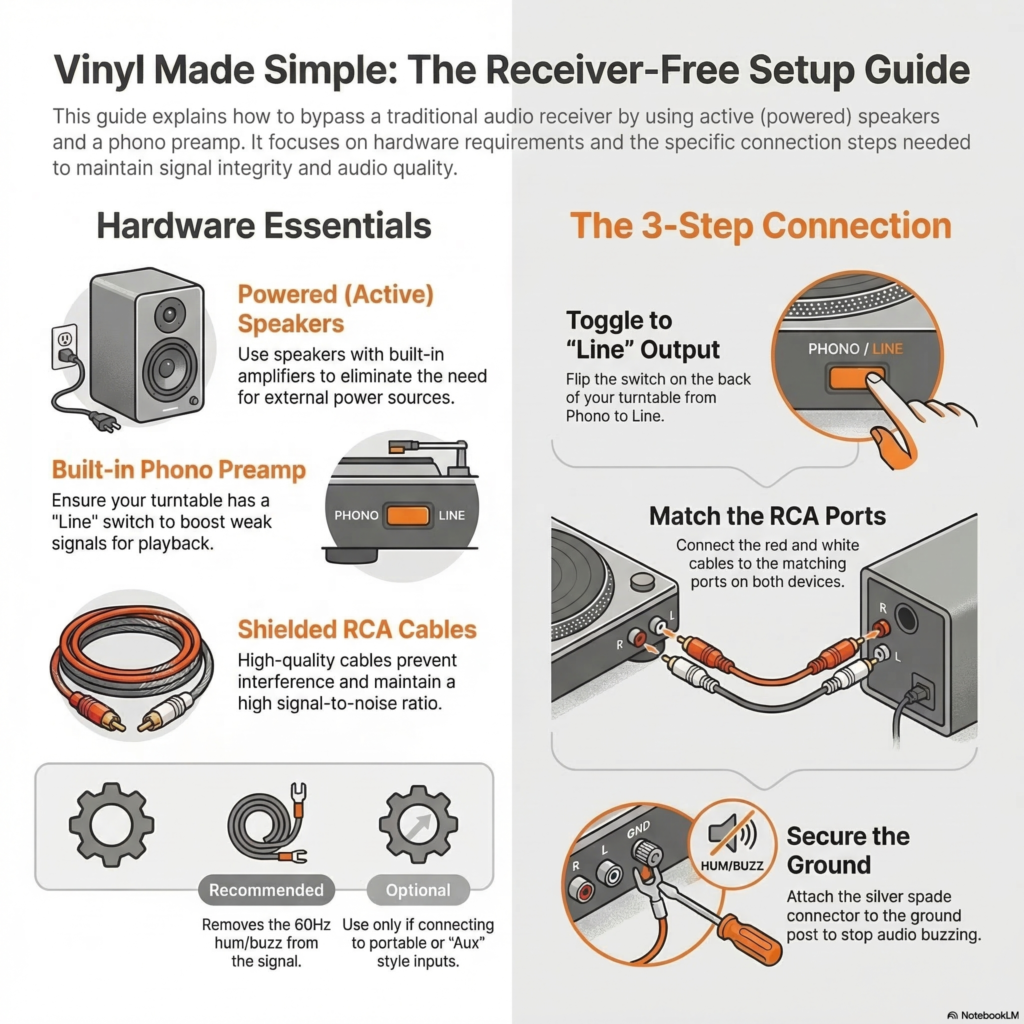
To connect a record player to speakers without a receiver, your checklist must prioritize signal integrity and physical stability. Beyond the turntable and active speakers, you specifically need a grounding wire to prevent humming, high-quality shielded RCA cables, and a dedicated phono preamp if your turntable lacks a “Line” output switch.
The Gear & Setup Checklist
Before you start plugging things in, we at MyHomeSpeakers suggest you have these essential accessories ready:
- Grounding Wire: Essential for removing the “buzz.” If your turntable has a small silver spade connector, it must be attached to the ground post on your preamp.
- RCA-to-3.5mm Adapter: Needed if you are connecting your record player to a portable speaker or a speaker with a “Headphone style” Aux input.
- Static Brush: Vital for cleaning the record before play; without a receiver’s EQ/filters, pops and clicks are much more noticeable.
- Vibration Dampening: Look for Sorbothane feet or a heavy Turntable Platter Mat to keep the needle steady near powerful active speakers.
- Carbon Fiber Stylus Cleaner: To ensure the signal stays crisp at the source.
Explainer Video
FAQ
Do I need a preamp if my speakers are powered?
Yes, unless your turntable or your powered speakers have a “Phono” input. Most active speakers only have “Line” inputs, which cannot amplify the raw signal from a record player. You will need a phono preamp to bridge the gap.
How do I tell if my turntable has a built-in preamp?
Check the back of your turntable for a switch labeled “Phono/Line.” If you see this switch, your turntable has a built-in preamp. Set it to “Line” to connect directly to powered speakers without an external receiver or extra preamp.
Can I connect a record player to a Bluetooth speaker?
Yes, if your turntable has a built-in Bluetooth transmitter. Simply pair the turntable with your speaker. If it doesn’t, you will need a Bluetooth Transmitter connected to the turntable’s RCA outputs (or preamp outputs) to send the signal wirelessly.
Why is my record player so quiet through my speakers?
This usually happens because you are missing a Phono Preamp. The signal from a turntable is too weak for standard speakers to play at a normal volume. Adding a preamp will boost the signal to “Line Level” for clear, loud playback.