
If you know how to replace a turntable belt, it is an advantage for you. Just imagine one day and you wake up to discover that your turntable is not spinning. What are you going to do?
Go out to look for a repairer or probably go online searching to know what is likely wrong with your turntable.
I guess the problem may be from the turntable. However, you have to check first before concluding. But assuming the problem is actually from the belt. What will you do?
So, in this article, I am going to show you a step-by-step guide on how to replace turntable belts.
You may wonder if you can replace it by yourself. Yes, it is possible if not simple.
Table of Contents
- 1 How to Know When to Replace Turntable Belt?
- 2 Instruments You Need To Replace Your Turntable Belt
- 3 How To Replace Turntable Belt
- 3.1 Step 1: Check Your Turntable’s Belt
- 3.2 Step 2: Buy a Proper Belt for your Turntable
- 3.3 Step 3: Unplug The Power Source From your Record Player
- 3.4 Step 4: Remove The Plastic Mat and Platter
- 3.5 Step 5: Stretch The Belt Over The Center Hub
- 3.6 Step 6: Put the Platter Back on The Turntable
- 3.7 Step 7: Test by Spinning The Turntable in Both Directions
- 4 The Best Turntable To Buy
- 5 The Best Turntable Belt To Buy
- 6 What are the differences between flat, square, and round turntable belts?
- 7 What is the “Don’t Forget” checklist for turntable belt replacement?
- 8 FAQ
- 9 Infographic on How to Replace a Turntable Belt
- 10 Replace Turntable Belt Video Explainer
- 11 Conclusion
How to Know When to Replace Turntable Belt?
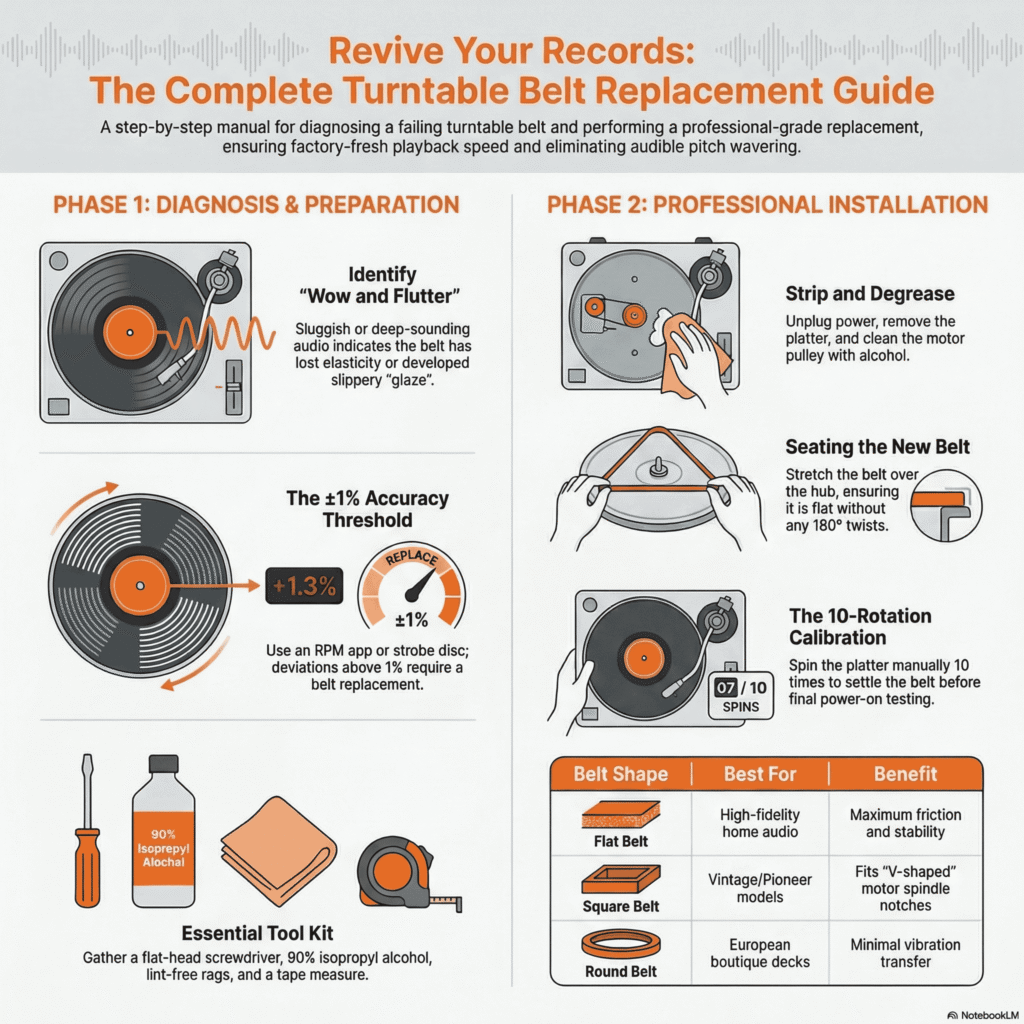
A failing turntable belt typically manifests as “wow and flutter”—audible pitch wavering caused by inconsistent platter speed. In our testing at MyHomeSpeakers, we’ve found that if your 33 1/3 RPM records sound sluggish or “deep,” the belt has likely lost its elasticity (stretched) or developed “glaze,” a slippery residue that causes it to lose grip on the motor pulley.
Identifying “Wow and Flutter” and Physical Decay
Before you begin the replacement, we recommend performing a quick diagnostic using specific technical entities to confirm the belt is the culprit:
- RPM Accuracy Apps: Use a smartphone app like RPM Speed & Wow or a physical Strobe Disc. If your deviation is higher than ±1%, your belt is likely overstretched.
- Visual Glazing: Inspect the inner surface of the belt. If it looks shiny or “glassy,” the rubber has hardened and can no longer provide the friction needed to turn the platter.
- Start-Up Lag: In our experience, if the platter takes more than 3 seconds to reach full speed, the belt is slipping against the motor spindle.
- Black Residue: If you see black “goo” or flakes on the sub-platter, the belt is chemically decomposing (melting) and needs immediate removal with 90% isopropyl alcohol.
Instruments You Need To Replace Your Turntable Belt
If you are planning to replace your turntable belt. The instruments below will be needed:
- Tape measure: You will use a tape measure to get the length of the belt.
- Flat-head screwdriver: You can use this tool to pry off the C-shaped clip if it is in your turntable.
- A hammer: It is used on a design without a clip to resist removal.
- A strobe disc: It is used to check the running speed.
- A lint-free rag and alcohol: You use them to clean your record player.
How To Replace Turntable Belt
- Step 1: Check Your Turntable Belt
- Step 2: Buy a Proper Belt for your Turntable
- Step 3: Unplug The Power Source From your Record Player
- Step 4: Remove The Plastic Mat and Platter
- Step 5: Stretch The Belt Over The Center Hub
- Step 6: Put the Platter Back on The Turntable
- Step 7: Test by Spinning The Turntable in Both Directions
Step 1: Check Your Turntable’s Belt
First of all, check to know if the problem is coming from the belt. The best way to know is to turn the turntable to know it will spin. So, if it does not spin, probably, you need to change it.

There are other ways to check it:
- The sounds of your record become deeper or lower-pitched.
- When the needle hits your record, pay attention to the change of speed which doesn’t run as usual.
Step 2: Buy a Proper Belt for your Turntable
After checking your turntable, you discover that it is faulty. The next step is to buy a new belt for your turntable.
Before you buy a new turntable belt, you have to put the following into considerations:
- width of the belt
- length of the belt
- thickness of the belt
While buying your belt, make sure to buy the same model as your old belt. However, if you can’t see your model, you can measure the circumference of the platter’s hub.
Step 3: Unplug The Power Source From your Record Player
It is time to unplug the power source from your record player. You do this to avoid any accident while replacing your turntable belt.


Although this rarely happens, you need to be very careful not to leave your turntable plugged in when changing the belt. We all know how powerful an electric shock can be.
It may not just damage the electric motor of your turntable, it may also have an effect on you. So, it is advisable to unplug your turntable from any power source.
Step 4: Remove The Plastic Mat and Platter
The next step to take while replacing your turntable belt is to remove the plastic mat and platter
The plastic mat is a surface where your record will sit on. Usually, you can remove it from the center shaft easily by pushing it off. Set it aside and start the next step.
The platter is a plastic or metal circle installed under the plastic mat, and you must remove it also.
Normally, the platter arrives with 2 access ports and holes. You can see the motor through the platter using the 2 access ports and holes. Sometimes, it may become necessary that you have to remove it away from the center shaft.
However, don’t worry about how to remove it. It is relatively easy to remove no matter what way it is attached:
- If it is attached to a small C-shaped clip, use a flat-head screwdriver to pry it off. Or
- Use a hammer if it is designed without a clip to resist removal.
Step 5: Stretch The Belt Over The Center Hub
After removing the platter, the next step to take is to stretch the belt over the center hub.
However, you won’t need to stretch the belt if everything’s ok, that is if it fits onto the circle snugly. What this implies is that you can place the belt in the circle’s center if it’s straight without being twisted or kinked.
Step 6: Put the Platter Back on The Turntable
After stretching the belt, the next step is to put the platter back on the turntable.
While you are trying to put the platter you will have to flip the platter first. So that the platter will return to the turntable without replacing the C-clip.
While doing this, you must be sure that all access holes expose the record player’s motor. This is a small metal shaft in the turntable’s corner.
Doing this allows the belt to hook the platter to turn the turntable while the motor is also turning. You can touch the motor by lining one of the access holes.
However, if your turntable does not have an access port on the platter, you will have to align the post on the button with a motor spindle.
Then, put the platter down and spin about 3 to 4 full rotations: 2 clockwise and 2 counter-clockwise
Finally, grab and hook the belt around the motor by pushing it through the access hole and stretching over the motor spindle.
Moreover, the small cap on the top will keep the belt from slipping off. Thus, you must make sure that the belt is pulled over that and rest on the motor.
Step 7: Test by Spinning The Turntable in Both Directions
Finally, after everything, you will have to test it by spinning the turntable in both directions. You must make sure that it meets the standard you want.
Even though you don’t expect the platter to spin till eternity, it doesn’t have to stop abruptly. It has to spin at least for a moment.
Sometimes, you may have a problem with how to tighten the record player well. That is to say, you don’t know how to attach the belt correctly, it may either be too tight or loose. Just carefully adjust the belt.
So, if you can’t operate the record player manually, that means it is too tight. On the other hand, if it fails to spin with the motor, what it means is that your belt is too loose.
The Best Turntable To Buy
You will not go wrong with buying these turntables for your audio player.
- Pro-Ject Debut Carbon EVO, Audiophile Turntable with Carbon Fiber
- Pro-Ject Debut Carbon DC Recordplayer
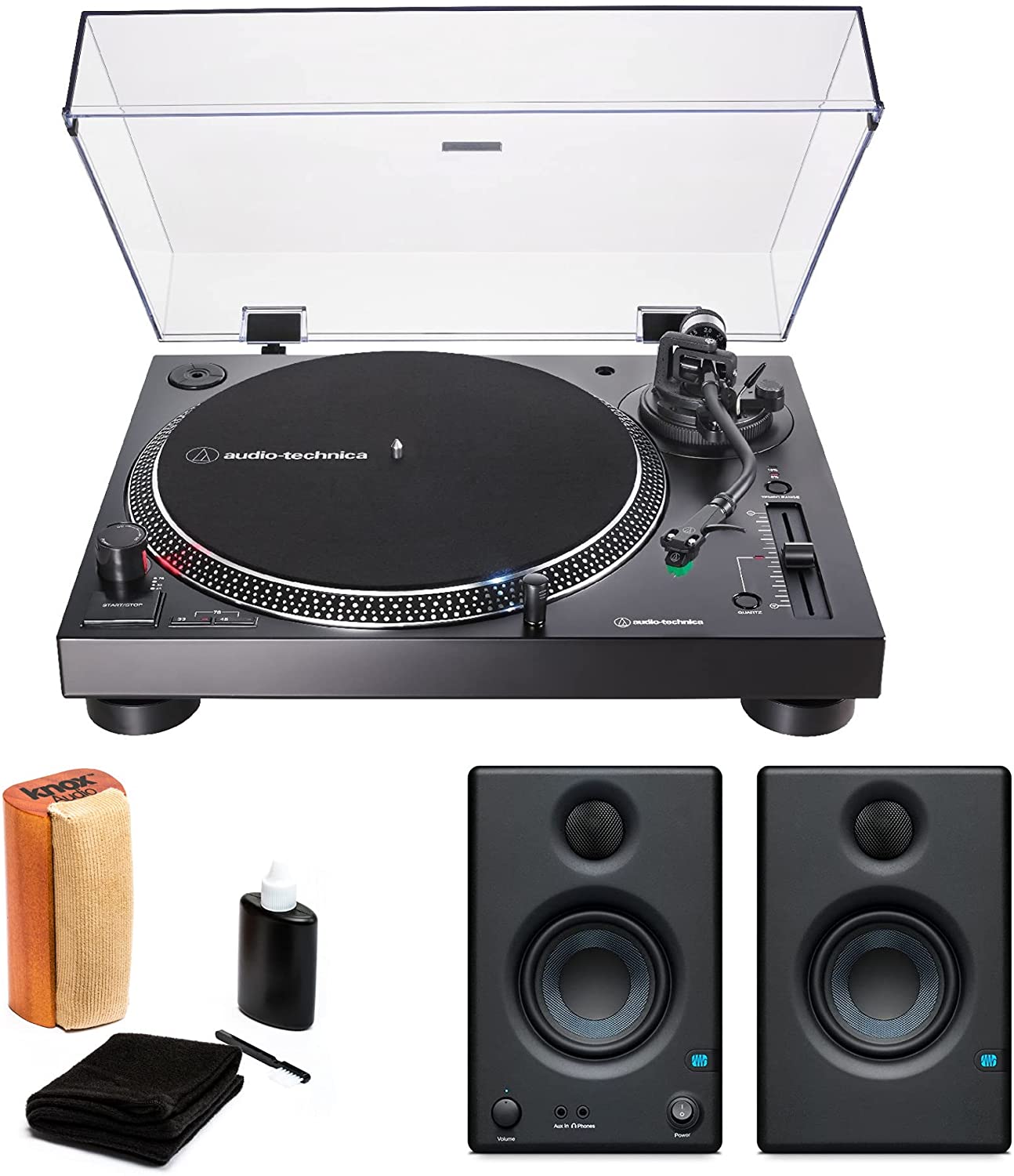
- Audio-Technica AT-LP60X-BK Stereo Turntable
- Audio-Technica AT-LP120XUSB-BK Direct-Drive Turntable
- Fluance RT81 Elite High Fidelity Vinyl Turntable
- Audio-Technica AT-LPW40WN Fully Manual Belt-Drive Turntable
- Crosley C100A-SI Belt-Drive Turntable
The Best Turntable Belt To Buy
What are the differences between flat, square, and round turntable belts?
The shape of your turntable belt is dictated by the design of your motor pulley and platter rim. Flat belts are the industry standard for high-fidelity home audio because their larger surface area provides maximum friction and stability. Square and round belts are more common in vintage “all-in-one” systems or specialized high-end decks with grooved pulleys.
Choosing the Correct Geometry for Your Setup
During our bench tests at MyHomeSpeakers, we’ve found that using the wrong belt profile can drastically increase motor noise and decrease speed accuracy:
- Flat Belts (The Audiophile Choice): Used by brands like Audio-Technica and Pro-Ject. These distribute tension evenly, reducing wear on the main bearing.
- Square Belts: Often found in vintage Technics or Pioneer belt-drive models. They must fit snugly into a “V-shaped” notch on the motor spindle.
- Round Belts: Common in European boutique decks (like Rega). These offer minimal surface contact, which can reduce vibration transfer but requires higher tension.
- Material Matters: While most are natural rubber, some 2026 aftermarket replacements use silicone, which resists “drying out” but may have different stretch coefficients that affect pitch.
What is the “Don’t Forget” checklist for turntable belt replacement?
Replacing a belt is only half the job; you must also clean the contact points to prevent immediate slip. Our testing shows that oils from your fingertips can transfer to the new rubber, causing it to fail prematurely. Always use tweezers or gloves during installation and ensure the motor pulley is free of old rubber debris.
The “Pro-Level” Setup Checklist
At MyHomeSpeakers, we follow this strict protocol to ensure a “factory-fresh” playback speed:
- Degrease the Pulley: Use a cotton swab with Isopropyl Alcohol to clean the brass or plastic motor pulley. Any leftover residue will cause the new belt to “walk” up and down.
- The “Twist” Check: After placing the belt around the inner hub, rotate the platter by hand 10 times. Look through the access ports to ensure there are no 180° twists in the rubber.
- Bearing Lubrication: While the platter is off, we suggest adding one drop of synthetic bearing oil to the spindle. This reduces the “drag” the belt has to overcome.
- Talcum Powder Tip: If your new belt feels “sticky,” a tiny dusting of unscented talc can prevent it from binding during the initial start-up cycle.
- Speed Re-Calibration: Once installed, run the turntable for 4 hours to let the rubber “settle” before performing a final RPM calibration.
FAQ
How often should I replace my turntable belt?
For optimal performance, replace your belt every 2 to 3 years. Even if you don’t use your record player often, rubber naturally dries out and loses its elasticity over time, leading to speed drift and increased wow and flutter.
Can I use a rubber band instead of a turntable belt?
No. Standard rubber bands do not have the precise thickness, width, or tension required for audio playback. Using one will cause significant speed fluctuations and may put unnecessary lateral stress on your motor, leading to permanent damage.
Why did my new turntable belt fall off?
A new belt usually falls off because it was installed with a twist or because the motor pulley is greasy. Clean the pulley with alcohol and ensure the belt is perfectly flat against the sub-platter rim before starting the motor.
How do I measure for a replacement belt if the old one is missing?
Use a piece of string to follow the belt’s path around the hub and motor pulley. Pull it tight, mark the overlap, and measure the length. Subtract 5% to 10% from that measurement to account for the necessary “stretch” or tension.
Infographic on How to Replace a Turntable Belt
Replace Turntable Belt Video Explainer
Conclusion
With the above steps, you can comfortably replace your turntable belt. You don’t need to rush out. Because you have the right knowledge. And you know what to do.
Another thing you must know is that. All the steps mentioned above are both significant and important. Therefore, you must not miss any of them.
Also, you must always remember to check your model. You must do this to avoid wasting both money and time.
Buying a suitable belt can influence how your model works. Besides, protecting yourself away from damage by unplugging the power source from the record player is extremely necessary.
Finally, it may become necessary to remove some parts. This will help you to put the turntable comfortably.
Also, remember to adjust the belt, this will help it to fit in well you just need to remove some parts to put the belt then let it all in the original positions.
Now, it’s time to enjoy (test) its amazing sounds